
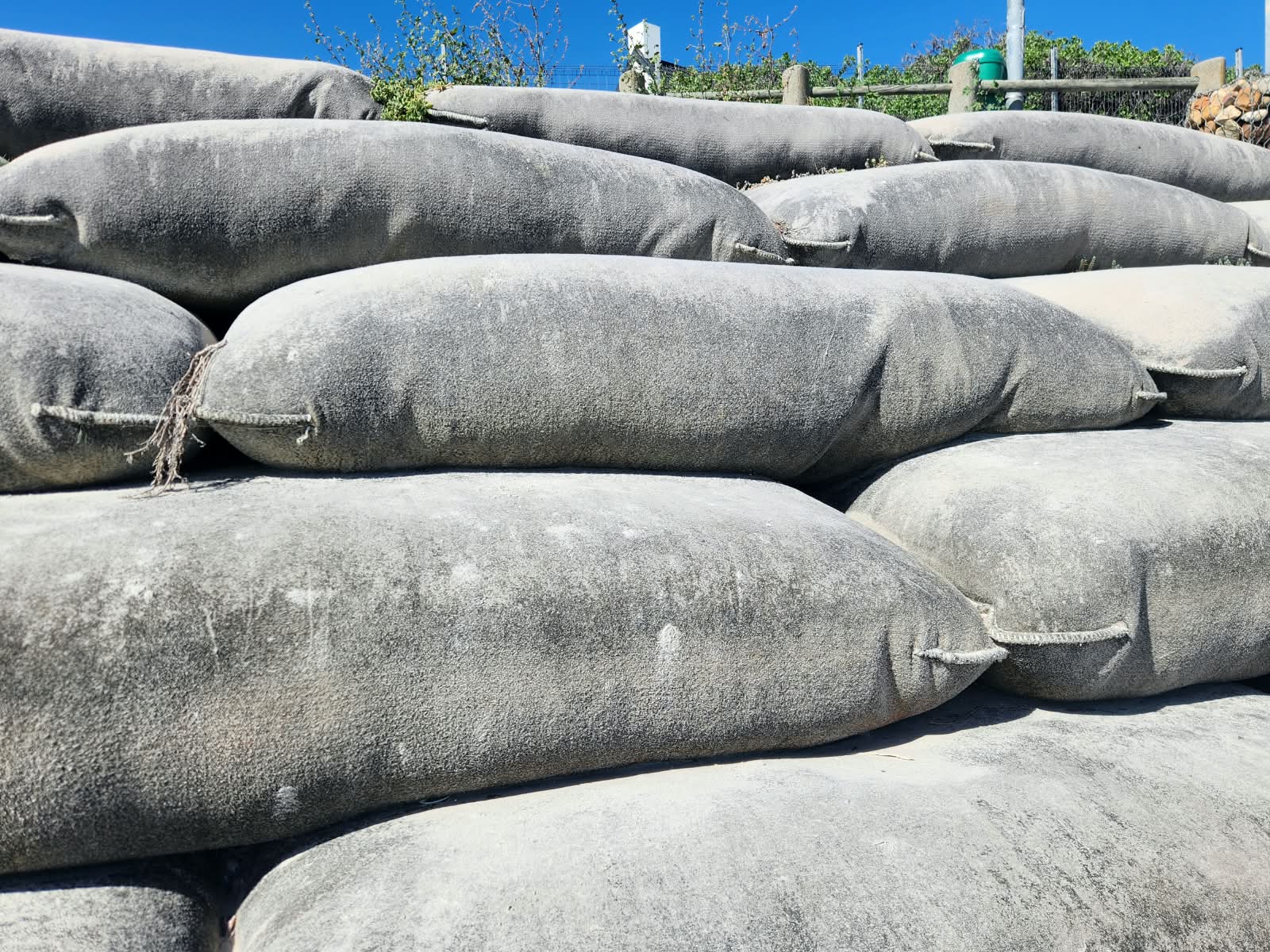
Woven and nonwoven container ranges
FlowTex GSC-W containers use woven geotextile selected for the required tensile and filtration properties. FlowTex GSC-NW containers use needle-punched nonwoven geotextile where the design calls for its deformation, filtration and protection behaviour. The group catalogue includes NW40, NW70, NW70HD, NW400, NW1350, NW1800 and NW4000 configurations; the current grade schedule confirms dimensions, fabric properties and nominal filled mass.
Containers can also be specified with monofilament, slit-film or combined fabric constructions where appropriate to the fill and service duty. Selection includes fines retention, hydraulic behaviour, abrasion, puncture, exposure and installation stresses. A nominal filled mass is not a lifting rating.
Horizontal placement and engineered stacked systems
Large-format containers can be configured for horizontal placement, battered revetments and engineered stacked arrangements. Container geometry, fill ratio, contact area, interface friction, foundation conditions, toe support and scour exposure all influence stability. A vertical or near-vertical wall needs a project-specific stability design; bag strength alone does not establish wall capacity.
We manufacture to the approved layout, including identified base, intermediate and crest units where required. Empty dimensions, filling tolerances, closure position and installation orientation are recorded so the delivered units correspond to the placement drawings.
Two-layer and three-layer fabric designs
Multilayer configurations can allocate separate functions to the structural fabric, filtration layer and outer protection or vegetation-supporting layer. Layer compatibility, differential stretch, drainage and seam load transfer are resolved before manufacture. Thickness or layer count alone does not establish performance.
For a vegetated finish, the design must provide a suitable growth medium, moisture regime and surface structure. A vegetation-supporting face is an additional construction detail, not an assumption that plants will establish through every woven or nonwoven bag.
Thread, stitching and closure qualification
Seam design specifies the thread grade, stitch type, number of rows, stitch density, edge allowance and seam orientation. Double-row and other multi-row seam constructions are selected by qualification testing rather than by a universal stitch rule.
GORE® TENARA® ePTFE thread is an option for specified exposed-service seams. Its UV resistance is inherent to the thread material. Thread selection also considers sewing compatibility, abrasion and the required seam strength. The manufacturer’s thread durability statement is separate from the service life of the complete container.
Where more than 80% seam efficiency is specified, acceptance is based on the tested seam assembly and corresponding parent-fabric properties. Filling-sleeve or tail closures, drawstring closures and permanently sewn closures are selected for the container configuration and site filling method.
Material durability matched to exposure
Polypropylene can be a useful choice for wet and chemically demanding duties, with grade-specific resistance to acids, alkalis and biological exposure. Material selection also checks temperature, concentration, oxidation, abrasion and UV exposure. Virgin or recycled origin is recorded with the supporting material specification; polymer name alone does not prove long-term suitability.
Service-life requirements, including a 100-year buried design requirement, need the selected grade’s durability evidence and reduction factors for the actual environment. Exposed coastal containers require a separate assessment of sunlight, wave action, abrasion, vandalism and inspection access.
Manufacturing inspection and release
| Control area | Evidence defined in the project inspection plan |
|---|---|
| Sewn assembly | Seam strength, stitch continuity, thread identification and seam efficiency against the specified parent fabric. |
| Container geometry | Empty dimensions, nominal filling arrangement, closures and placement identification. |
| Installation interface | Approved fill, handling method, stacking design and exposure requirements. |
Applicable methods, sampling frequencies, acceptance limits and independent testing requirements are agreed for the supplied grade and manufacturing scope.
Request a manufacturing proposal
Container drawing, target filled geometry and mass, fill material, placement and lifting method, wave or flow exposure, quantity and project location.
Request a manufacturing quoteJohannesburg: sales@geosynthetics.co.za
Cape Town: sales@geosyntheticsafrica.com