
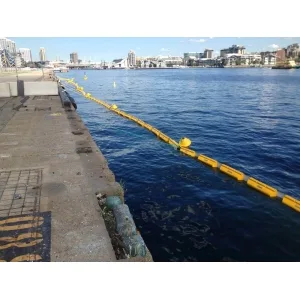
Skirt fabric and containment function
A permeable geotextile skirt allows water exchange while retaining a proportion of suspended sediment according to the selected fabric and operating conditions. An impermeable membrane skirt provides a different containment arrangement. Particle-size distribution, sediment concentration, flow and the required management objective inform the selection.
Fabric properties include tensile and tear behaviour, opening characteristics where permeable, abrasion and UV exposure. The environmental management plan defines monitoring and action requirements. Curtain installation is one part of sediment control, alongside the construction method and site water management.
Flotation, ballast and load paths
We coordinate flotation dimensions and enclosure, skirt attachment, reinforcing webbing, ballast pockets and connection hardware. Load must pass through the intended structural elements rather than concentrate at an unreinforced fabric edge. Bottom ballast helps maintain the skirt arrangement; moorings resist the design environmental loads.
Factory section lengths and joint details are chosen for deployment, transport and retrieval. Connections can incorporate the specified skirt closures and float-level hardware. Exposed components are selected for the intended freshwater, marine or industrial environment.
Site-specific configuration
Provide water depths, tidal or operating-level range, current direction and velocity, wave and vessel exposure, work duration and the proposed curtain alignment. The designer establishes skirt clearance, anchoring, turning points, access openings and the required operating limits.
A deeper skirt can increase environmental loads. Curtains must be designed for the flow and deployment method; product-class names do not replace a review of the actual site. Where the construction sequence changes, the curtain arrangement and moorings are reviewed with it.
Production checks and deployment readiness
The inspection plan covers material identity, skirt dimensions, seam continuity, reinforcing strips, flotation enclosures, ballast pockets and section connections. Trial assembly can confirm that mating sections and hardware fit before dispatch.
Sections are labelled and packed to the deployment sequence, with identified lifting or handling points and the relevant assembly instructions. Installation scope can include positioning and connection work, with the agreed mooring and inspection requirements.
Manufacturing inspection and release
| Control area | Evidence defined in the project inspection plan |
|---|---|
| Skirt assembly | Material, dimensions, seams, reinforcement and filter properties where specified. |
| Components | Flotation, ballast, hardware and connection compatibility. |
| Release | Section identification, trial fit, packing and deployment instructions. |
Applicable methods, sampling frequencies, acceptance limits and independent testing requirements are agreed for the supplied grade and manufacturing scope.
Request a manufacturing proposal
Site plan, depth and level range, current and wave conditions, sediment information, alignment, duration and deployment access.
Request a manufacturing quoteJohannesburg: sales@geosynthetics.co.za
Cape Town: sales@geosyntheticsafrica.com