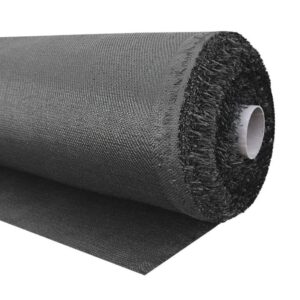
FlowTex Monofilament Woven Geotextiles
Our FlowTex monofilament woven fabrics combine water transmission with soil or solids retention. We supply the fabric, manufacture suitable bags and containers, and install geotextile systems for drainage, filtration and dewatering projects.


Our FlowTex™ FT Series is specified where high water flow, resistance to clogging, and consistent pore geometry are required-making it suitable for dewatering, drainage, and hydraulic control in demanding civil and mining environments.
1. Water transmission for drainage and dewatering
Select normal-to-plane water flow for the design hydraulic conditions and fabric grade. Flow rate is a material test property; the installed system also depends on soil or slurry compatibility, confinement, drainage path and outlet conditions.
2. Opening size and soil retention
Select the declared opening-size property together with the soil grading or dewatering trial results. Opening size must balance solids retention and water transmission for the actual application; a single opening-size value does not establish filtration suitability.
3. Filtration compatibility
Assess soil retention, hydraulic capacity and clogging risk together. Fine soils and process slurries can require material-specific filtration trials or laboratory assessment before the fabric is selected.
5. Exposure and durability
Confirm polymer and grade suitability for the liquid chemistry, temperature, UV exposure and abrasion conditions. Chemical resistance and exposure limits must be assessed for the proposed material and service conditions.
Select the weave for the required function
Monofilament, slit-film and other woven constructions have different hydraulic and mechanical properties. Compare the declared grade data with the specified filtration, separation, reinforcement or dewatering function before procurement.
Partner with Africa’s Woven Monofilament Geotextile Specialist
Whether you’re lining a dam drainage layer, protecting a coastal embankment, or filtering industrial effluent, Geosynthetics South Africa ensures you have the right fabric, right grade, and right support for your project.
Applications
Geosynthetics South Africa supplies FlowTex woven monofilament geotextiles for a range of critical applications:
Drainage Systems - subsoil drains, underdrains, trench drains, collector drains
Filtration Layers - retaining soil while allowing high water throughput in riverbanks, coastal works, and reservoir inlets
Dewatering Systems - in geotextile tubes, dewatering pads, and filtration units for mining, municipal, and industrial slurries
Scour & Erosion Control - under riprap and armour layers in marine and river projects
Sand & Rock Bags - geotextile containers for coastal defence and ballast applications
Infrastructure Protection - filtration wraps in road embankments, bridge abutments, and retaining walls
| Property | FT50 | FT 300 | FT 350 |
|---|---|---|---|
| Water Permeability (EN ISO 11058, mm/s) | 50 | 300 | 350 |
| Apparent Opening Size (O90) (EN ISO 12956, μm) | 180 | 350 | 600 |
| Tensile Strength MD/CD (EN ISO 10319, kN/m) | 40 / 35 | 44 / 40 | 40 / 35 |
| CBR Puncture Resistance (EN ISO 12236, kN) | 5.0 | 6.0 | 5.0 |
| Roll Width × Length (m) | 5.20 × 100 | 5.05 × 100 | 5.05 × 100 |
| Material Type | Polypropylene (PP) | PP / PE Blend | PP / PE Blend |
Why choose FlowTex Monofilament Woven Geotextiles?
- Woven fabrics for water transmission
- Fabricated bags and containers
- Supply, fabrication and installation support
Installation and technical guidance
Design and procurement inputs
Woven slit-film, monofilament and high-strength reinforcement fabrics serve different functions. Specify the required strength, strain, soil retention and flow properties rather than treating the range as interchangeable.
Provide the product grade or performance specification, drawings or BOQ, quantities, site location and required date. We will define supply, delivery and any agreed installation and QA/QC responsibilities in the quotation.
Request a product-specific quotation →6. Installation and quality control
Prepare the support surface, deploy without damage and provide the specified overlaps or seams. Inspect roll identification, damage, connections and cover placement, and retain the required project quality records.
4. Strength and installation survivability
Check tensile, puncture and seam requirements for the actual installation and operating loads. Container and dewatering duties also require appropriate fabricated dimensions, seam capacity, pumping control and handling arrangements.
SELECTION · SPECIFICATION · PROJECT SUPPLY
Choose the right specification
Select the fabric construction for the specified separation, reinforcement or filtration function.
- Confirm yarn construction, tensile behaviour and the project’s required reporting basis.
- Where water passes through the fabric, review soil retention and hydraulic compatibility.
- Approve joints, orientation, interfaces and cover-placement requirements for the actual grade.
Define the quality records
Verify fabric identification and condition, orientation, joints and the accepted layer build-up before covering.
For a useful quotation: send the grade or performance specification, quantity, location, required date and scope. Availability, delivery and installation responsibilities are confirmed in the quotation.
Why Geosynthetics South Africa
One enquiry coordinates the specified product, technical submission, delivery and any agreed installation and QA/QC scope. We define quantities, programme, responsibilities and handover requirements against your project.