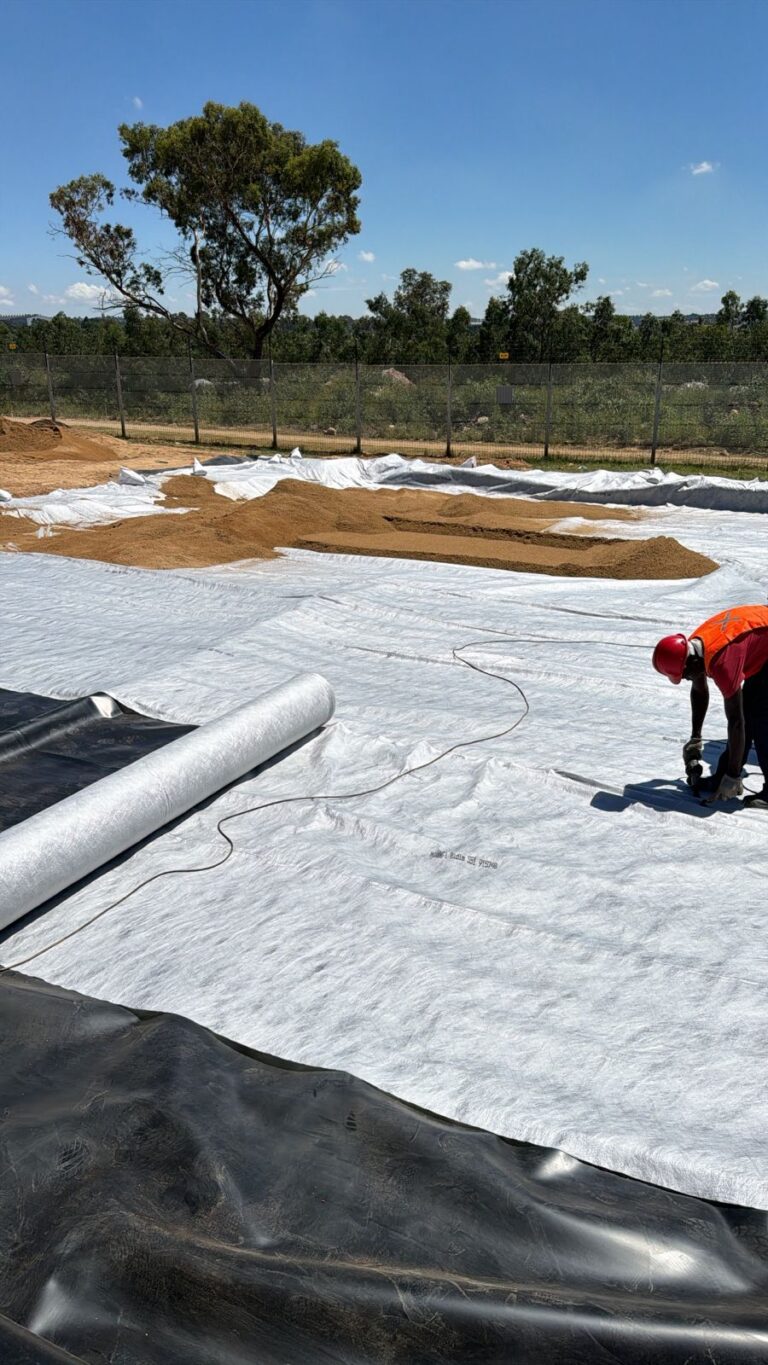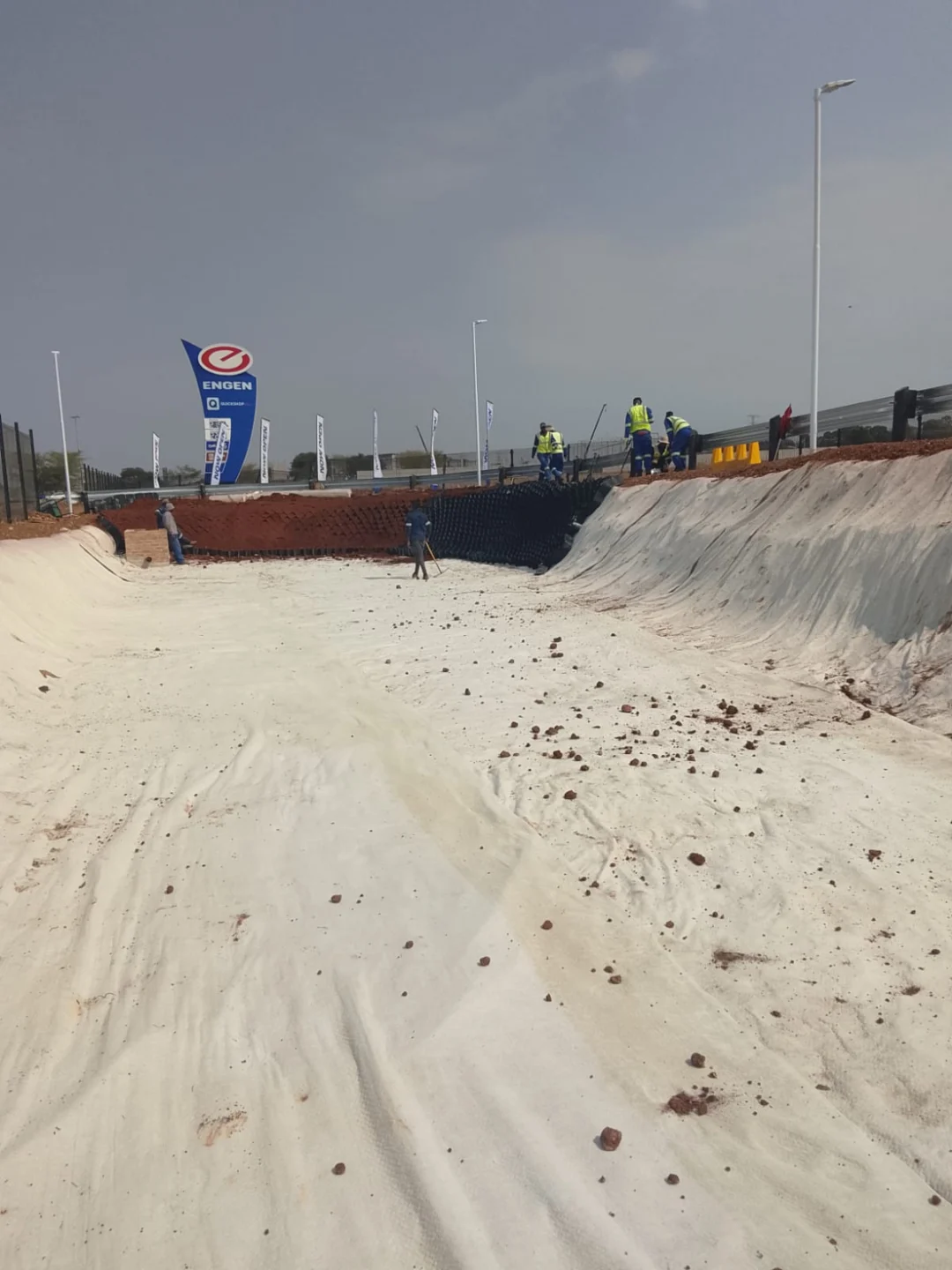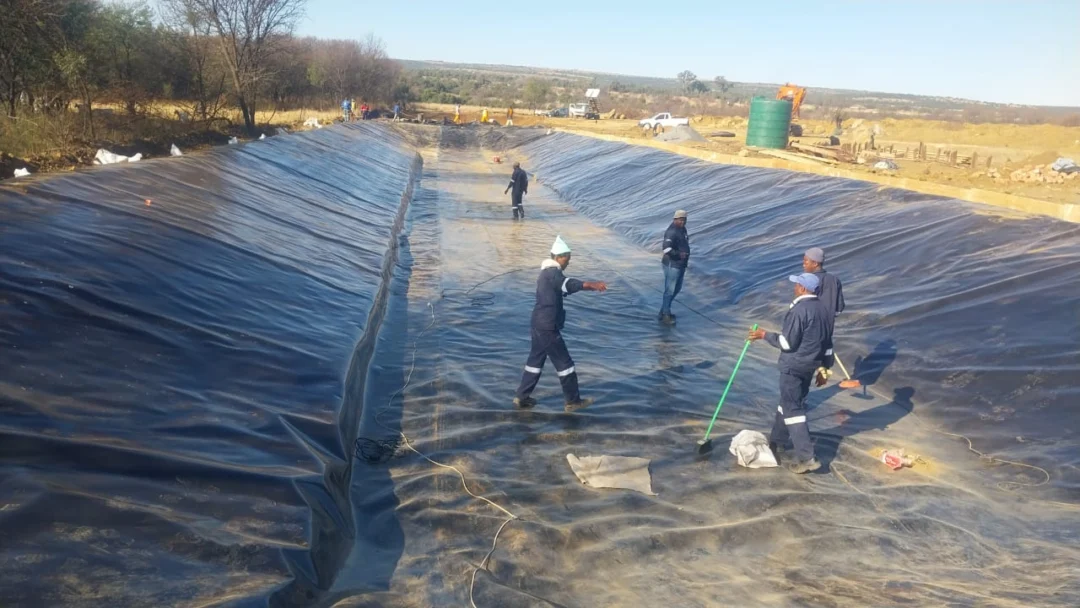
High-Complexity Composite Lining & Leak Detection System - Danielskuil Reservoir, South Africa
Composite reservoir lining system installation at Danielskuil, South Africa -
integrating specialty EVA geomembrane, leak detection layer and QA/QC-controlled installation within a confined, structurally complex environment.
Project at a glance
- Application
- Concrete reservoir lining
- Location
- Danielskuil, South Africa
- System
- 1.5 mm EVA + drainage & ELD layer
- Complexity
- 37 internal support pillars
Project Overview
Geosynthetics Africa delivered a fully integrated composite lining system for a structurally complex concrete reservoir in Danielskuil, South Africa.
This was not a standard earth dam application. The project involved:
- A confined-access concrete reservoir
- Entry through a 1m x 1m access hatch
- Internal structure comprising 37 vertical support pillars
- Vertical walls and complex geometry requiring advanced installation techniques
The system required zero-leakage performance, full QA/QC validation, and execution under strict health and safety controls.
Engineering Challenge
This project presented multiple high-risk and non-standard challenges:
- Restricted access limiting material handling and equipment movement
- Complex internal geometry, including multiple vertical pillars and wall interfaces
- Requirement for vertical wedge welding techniques, rarely applied in confined structures
- Installation within a low-light, confined space environment
- High consequence of failure requiring 100% containment assurance
Integrated System Design
Geosynthetics Africa delivered a composite geosynthetic lining system, integrating multiple components into a single engineered solution:
- Specialty EVA geomembrane liner (1.5mm)
- Selected for flexibility and performance in complex structural conditions
- Geodrain LD500 cuspated drainage layer
- Acting as a leakage detection and drainage medium
- Durafoil electronic leak detection layer
- Enabling full system integrity verification
This multi-layer system was designed to ensure:
- Immediate detection of any defects
- Long-term containment reliability
- Compatibility with structural constraints of the reservoir
Execution Strategy
Geosynthetics Africa executed the project under a fully integrated delivery model, covering:
- Material selection and supply
- System design coordination
- Installation planning under confined access conditions
- QA/QC-controlled installation and testing
Key execution elements included:
- Right-sizing of liner panels to accommodate access constraints
- Controlled material handling through restricted entry points
- Sequenced installation to manage confined working space
- Integration of all system components without interface risk
Specialist Installation Techniques
Due to the complexity of the structure, advanced installation methods were applied:
- Vertical wedge welding across walls and structural elements
- Extrusion welding for detailing around penetrations and complex junctions
- Precision installation around 37 support pillars
- Mechanical anchoring system using battens and EPDM rubber
This level of execution is not typical of standard lining projects and required highly skilled installation teams and controlled procedures.
Quality Assurance & Quality Control (QA/QC)
QA/QC was embedded throughout the project and formed a critical component of delivery.
Testing and validation included:
- Trial welds and procedure validation prior to installation
- Air channel pressure testing for dual seam verification
- Vacuum box testing of welded seams
- Electronic leak detection (ELD) across the full liner system
All testing was documented and verified to ensure:
- Full system integrity
- Compliance with international standards
- Traceability for client and engineering review
Health, Safety & Environmental (HSE) Management
Given the confined nature of the reservoir, strict HSE protocols were implemented:
- Confined space entry procedures
- Continuous gas monitoring
- Working at height controls within the structure
- Installation under controlled lighting conditions
- Training and integration of local workforce (10 personnel recruited and upskilled)
Project Outcome
- 100% containment achieved
- Zero leakage confirmed through electronic testing
- Full QA/QC documentation issued
- System delivered in line with engineering design and performance requirements
Integrated Delivery Model in Practice
This project demonstrates Geosynthetics Africa’s ability to deliver complex geosynthetic systems under a single accountable execution model:
- Specification-compliant material supply
- Controlled logistics and site execution
- QA/QC-certified installation and validation
Conclusion
The Danielskuil Reservoir project highlights Geosynthetics Africa’s capability to execute high-complexity, multi-layer geosynthetic systems in challenging environments.
Where projects demand more than standard installation -
Geosynthetics Africa delivers integrated systems, engineered and executed to perform.
Key Project Highlights
- 1.5mm EVA specialty liner installed
- Composite leak detection system integrated
- 37 structural pillars navigated
- Confined access installation (1m x 1m entry)
- Full QA/QC validation including ELD
- Zero leakage performance achieved